

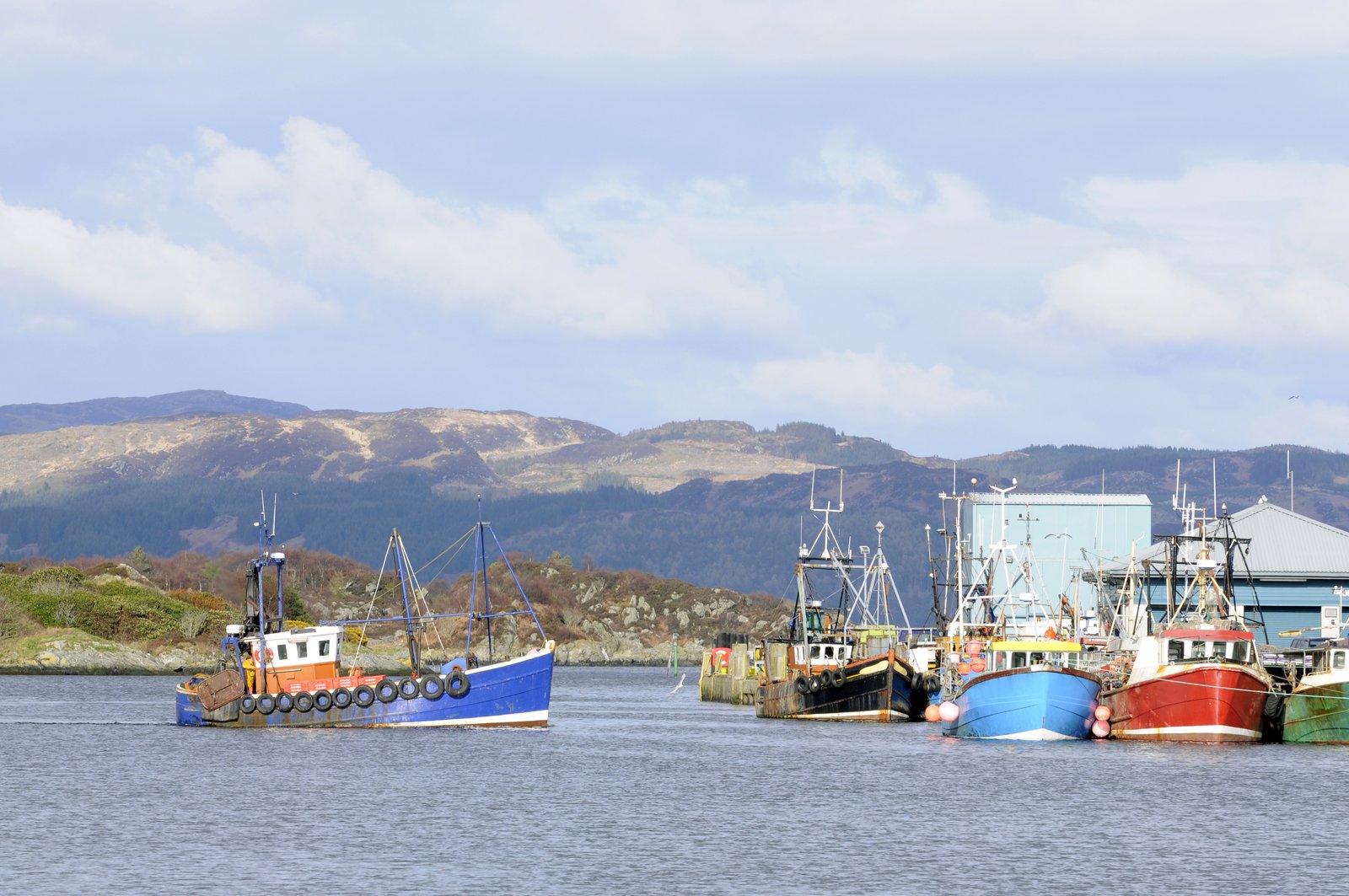
The Scottish Government has confirmed that ministers do not currently have powers to require compensation payments in relation to energy infrastructure, leaving affected parties to negotiate privately with developers. The answer arrives as Holyrood prepares to debate calls for greater protection for fishing businesses losing access to established grounds as offshore wind expands.
Scottish Ministers can consent major energy infrastructure around Scotland’s coast, but the Government says they cannot require developers to compensate fishermen or other parties financially affected by those projects.
The position was set out by Energy Secretary Stephen Gethins in a written parliamentary answer published on 6 October.
Asked what mechanisms were available to compensate communities or industries adversely affected by energy developments, Gethins said Scottish Ministers “do not currently have powers to require compensation payments in relation to energy infrastructure”.
Any compensation arrangement, he said, is therefore a matter for private agreement between the developer and the affected party.
The answer exposes a gap between the public decision to permit infrastructure and the private negotiations that can follow when an existing economic activity is disrupted by it.
Fishing Has Brought the Question to the Surface
The issue is particularly acute offshore, where Scotland is attempting to expand renewable electricity generation in seas that are already working environments.
Commercial fishing grounds, offshore wind leases, subsea cables, shipping routes, oil and gas infrastructure, marine protected areas and military activity can all occupy or constrain the same marine space.
Gethins said the Government had discussed the subject with the Scottish Fishermen’s Federation on 9 September.
A Scottish Parliament debate on the fishing industry on 7 October will now bring the compensation question directly into the chamber.
Amendments lodged ahead of that debate take different approaches but share concern about displacement.
A Conservative amendment calls for fishermen to be protected from, and compensated for, financial losses arising from offshore wind expansion into long-established fishing grounds.
A Liberal Democrat amendment calls for a comprehensive compensation scheme for displaced fishers alongside a new settlement for marine spatial planning.
Labour’s amendment focuses on cumulative pressure on marine space and the delayed replacement for Scotland’s national marine plan.
Those proposals have not yet become government policy. They do, however, place a specific financial question alongside the broader argument about how Scotland allocates its seas.
Community Benefit Is Not Compensation
Scotland already has a long-established policy framework for community benefits from renewable-energy development, but those payments operate on a different basis.
The Scottish Government published its first Good Practice Principles for community benefits from onshore renewable energy in 2014 and revised them in 2019.
The framework encourages developers to provide voluntary benefits to communities hosting renewable infrastructure. Those arrangements can support local funds, community facilities and other projects.
They are not payments imposed through the planning system and they are not supposed to purchase consent for a development.
The Government’s own guidance also separates community benefit from compensation.
That becomes important when a business can identify a direct economic loss rather than a general local impact. A fishing operator losing access to grounds because of construction or safety zones is in a different position from a village receiving a voluntary community fund because turbines or transmission infrastructure are nearby.
Under the position confirmed by Gethins, the former may still have to negotiate directly with the developer unless another legal entitlement applies.
The Sea Has Become an Infrastructure Map
When Scotland’s first modern renewable-energy community-benefit principles were being developed, the central political debate concerned onshore wind.
The geography of the energy transition is now substantially more complicated.
ScotWind and subsequent offshore leasing have created large areas of potential wind development around the Scottish coast. Those projects require not just turbines but cable corridors, substations, ports, construction areas and connections to the wider electricity system.
Existing fishing activity does not disappear simply because another use of the sea is authorised.
Nor is displacement necessarily permanent or total. Different fishing methods and project designs can coexist to different degrees, while some restrictions may apply mainly during surveys or construction. The economic impact therefore depends on location, gear type, species, seasonal activity, navigation requirements and the design of an individual project.
A national compensation formula would have to decide how those differences were valued. The absence of one leaves developers and fishing businesses to reach agreements case by case.
Consent and Compensation Sit on Different Tracks
Scotland’s devolved institutions exercise substantial powers over marine licensing and the consenting of generating stations, while electricity markets and significant parts of energy regulation remain reserved to Westminster.
That division already makes large energy projects institutionally complex.
The new ministerial answer identifies another boundary within the devolved system itself: possession of a consenting power does not automatically provide a power to order financial compensation for every economic consequence arising from the consent.
Existing private-law rights, property rights and specific statutory compensation arrangements may apply in particular circumstances. Gethins’ answer is narrower: the Scottish Government does not currently possess a general power to require compensation payments in relation to energy infrastructure.
Changing that position would therefore require more than revising voluntary guidance.
The Question Is Moving From Guidance Towards Law
The Scottish Government has already been reviewing its approach to community benefits as the scale of renewable and network development increases.
Its recent work has considered energy storage, shared infrastructure, governance and the cumulative effects of multiple developments.
But the language used in that process remains deliberate. Community benefits are voluntary arrangements intended to share some of the value created by development. They are not a statutory compensation regime for demonstrable business loss.
The pressure from fishing representatives presents a harder problem because a fishing business may be able to identify a particular ground, an established pattern of use and a measurable loss of income.
If Parliament concludes that private negotiation is no longer sufficient, it would have to decide who qualifies, what evidence of loss is required, how compensation is calculated, whether payments fall on developers or the public purse, and how disputes are determined.
Those questions will now sit behind the fishing debate on 7 October. Scotland’s offshore-energy programme is moving from lease maps and generation targets into increasingly crowded working seas, where the economic cost of sharing space can fall on businesses that were there before the new infrastructure arrived.
Sources
Written Question S7W-03570
Scottish Parliament, answered 6 October 2026
https://www.parliament.scot/chamber-and-committees/questions-and-answers?page=3
Scotland’s Fishing Industry — Motion S7M-01460
Scottish Parliament, October 2026
https://www.parliament.scot/chamber-and-committees/votes-and-motions/S7M-01460
Amendment S7M-01460.3
Scottish Parliament, October 2026
https://www.parliament.scot/chamber-and-committees/votes-and-motions/S7M-01460-3
Amendment S7M-01460.4
Scottish Parliament, October 2026
https://www.parliament.scot/chamber-and-committees/votes-and-motions/S7M-01460-4
Good Practice Principles for Community Benefits from Onshore Renewable Energy Developments
Scottish Government, 2019
https://www.gov.scot/publications/scottish-government-good-practice-principles-community-benefits-onshore-renewable-energy-developments/